
The Forever Forest: Art as Environmental Activism
Cultivating belonging & action through visual arts. Story 3
At the International School of Uganda (ISU), visual arts teacher Jill Pribyl is creating transformative learning experiences. Through thoughtfully designed projects, she connects students to their sense of identity, place, and global citizenship while fostering deep community engagement. I recently had the privilege of sitting down with Jill to explore how visual arts can amplify belonging, well-being, meaningful connections and community engagement. By LeeAnne Lavender, AISA Community Engagement & Learning Coordinator.
Perhaps most ambitiously, Jill has guided her fourth-grade students in creating the “Forever Forest,” an installation made entirely from plastic waste that connects artistic expression with environmental awareness and community partnership.
Inspired by a Dutch artist, Thomas Dambo, who created a similar installation in Mexico City, the project addresses Uganda’s plastic waste problem while making a powerful visual statement. Jill partnered with the Kiteezi Women’s Center, an organization where women collect, clean, and sell trash from a local dump site to support their families.
“I wanted to engage in a collaboration,” says Jill. “I wondered, what if we had the women collect trash for us, for our forest, and then we pay them? And then, in addition to that, the women could come and actually make the forest with us.”
The fourth graders raised money by selling handmade bookmarks, enough to pay the women for their materials and time. When the women came to ISU, students worked alongside them to construct the installation, breaking down social barriers and creating meaningful human connections.
“The women felt like the students accepted them, and they weren’t looked at as people who work at the dump site. They were respected and included,” Jill shares.
The Forever Forest became part of a service experience at the AISA-GISS student conference hosted at ISU in February, where it served as both an art installation and a provocative reminder of our consumption habits. Ultimately, the forest will find a permanent home at the Kiteezii Women’s Center’s new building, something to represent this reciprocal community partnership.
You don’t need to be fearless to reach your goals, you just need to be willing. Willing to try, willing to learn, and willing to believe that you’re capable of more than you know. The road may not always be smooth, but growth rarely is. What matters most is that you keep going, keep learning, and keep believing in the version of yourself you’re becoming.
See Story 4: The Arts as a Bridge to Community
Please enjoy the full interview with Jill about the grade 3 and 5 units, as well as a grade 4 unit that features the community partnership with the Kiteezi Women’s Centre.
-
Jill arrived in Uganda 20 years ago as a Fulbright Scholar in Makerere University’s Performing Arts Department. “I came to Uganda as a practicing artist—both visual and performing—and transitioned into education from there,” she explains. “My experience in teaching comes from a very strong arts background into education, not education to be an art teacher. So I think that’s a different inroad.”
This artist-first approach informs everything about her teaching philosophy. When discussing strengths of the International Baccalaureate’s Primary Years Programme (PYP) curriculum, Jill notes: “I’ve really loved working in the PYP because it is so flexible and open, and it allows for teachers to have a lot of agency in how they’re approaching the subject matter, and what lessons or units they decide to develop.”
Perhaps most powerfully, Jill models what it means to be a practicing artist alongside her students. During a recent Literacy Week at ISU, she worked on illustrations for her upcoming children’s book, The Brush, while her students tackled realistic art projects of their own.
“[The students] were really engaged in my process, and of course, I was also engaged in their process of drawing realistically,” Jill reflects. “Being vulnerable by sharing something that isn’t perfect yet, and that they had a say in some of the creative decisions I made – that kept the students excited.”
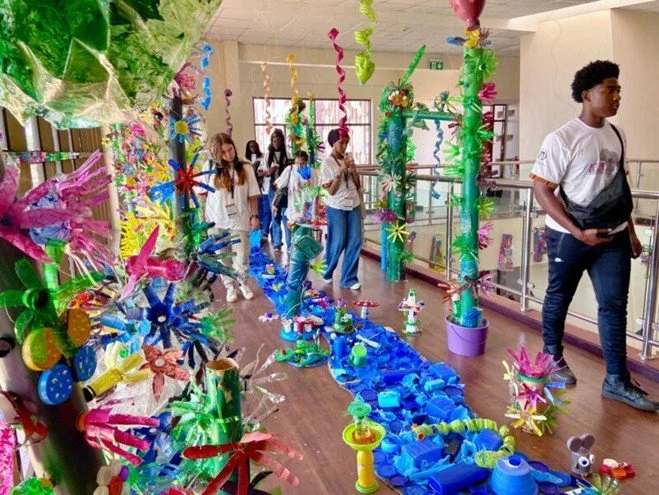
The Forever Forest is an art installation made from upcycled plastic on the second floor of the ISU Arts Centre.